We hold every FDIC-insured bank’s call reports, line by line. Every screen in the Platform reads that record, and every figure on it names the code it came from.
What we hold
A call report is not a document. It is addressable line items: 3,761 distinct ones filed in Q2 2026.
Every one of them has an eight-character MDRM code naming exactly which line, on which schedule, on which basis. The first four characters name the reporting basis, the last four name the item. That code is the unit the product is built on.
Every bank
Every FDIC-insured institution’s call reports, as filed.
41 quarters
2016Q2 to 2026Q2, every quarter each bank filed.
Every figure coded
Each figure carries its MDRM code, for example:
RCON2170 · total assets, domestic offices
Beside the filings we hold the FFIEC’s Uniform Bank Performance Report: its published ratios and its peer group statistics. When the UBPR and our arithmetic disagree, the screen tells you which one you are reading rather than picking one quietly.
What you send
The loan, deposit and general ledger trial balances your core prints each night, and your securities and borrowings each month. Nothing to install and nothing to connect. Names, addresses and tax IDs are dropped before anything is stored, and account numbers are hashed. The file as sent is held encrypted for 7 days, then deleted. Each night is footed to your general ledger, and each quarter-end to your Call Report.
What we read
Eight domains, 57 signals.
A signal reads filed line items, runs a stated formula, and is measured against a published line with the regulation’s own operator. Open one and it shows the items it read, the formula, the seams in the data, and the rule it is measured against. Where no published line exists, it says so and carries no verdict.
Capital10 signals
Lending capacity9 signals
Deposit franchise7 signals
Liquidity structure6 signals
Securities & rate7 signals
Credit6 signals
Earnings quality7 signals
Efficiency & scale5 signals
Every peer figure is the bank’s FFIEC-assigned peer group, named on the line: “trimmed avg, theirs” where the FFIEC publishes the ratio, otherwise “avg, ours” with the bank’s rank.
The Platform
Nine surfaces, one record.
Each surface reads the same figures. A number on one screen is the same number, from the same source, on every other.
Your bank
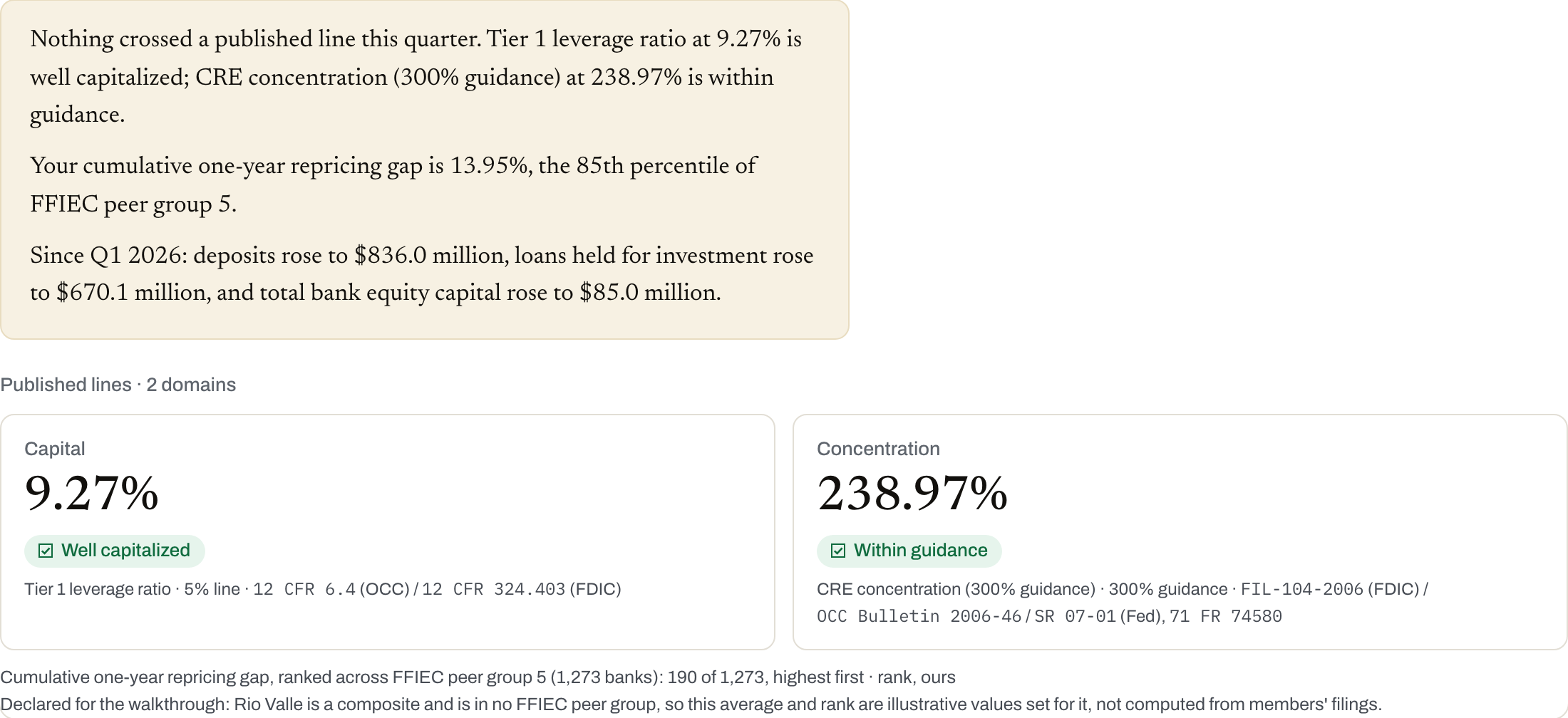
Your institution as filed. What crossed a published line, what sets it apart from the peer group the FFIEC assigns it, what moved since last quarter, and every signal across the eight domains. Open any figure and it shows the line items it read and the formula it ran.
Your bank, as filed, beside its FFIEC-assigned peer group.
Your numbers
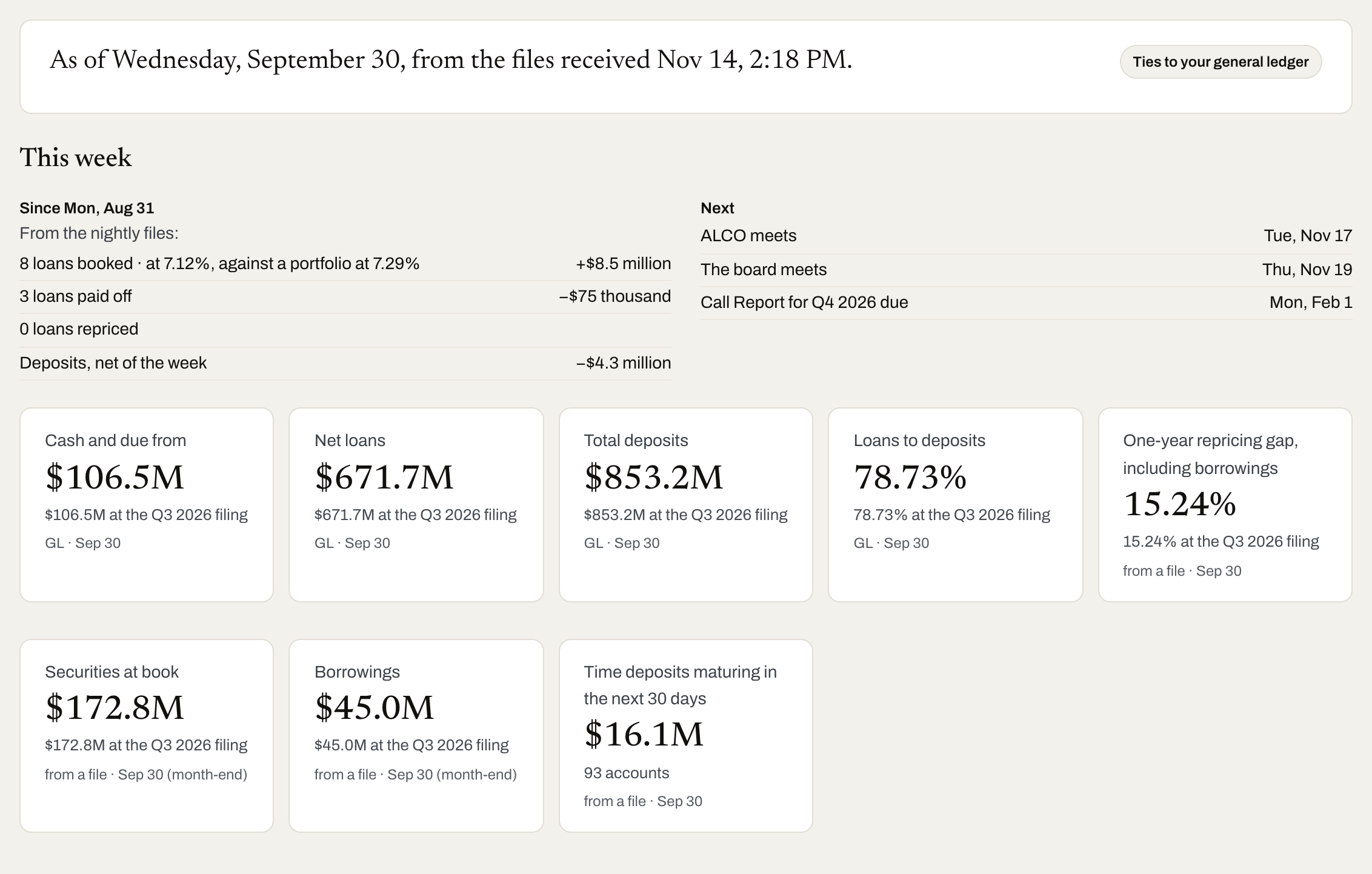
Last night's balances, what moved since the night before and why, anything near a limit you set, and what is next on your calendar.
Your numbers: last night, what moved and why, and what is next.
Analytics
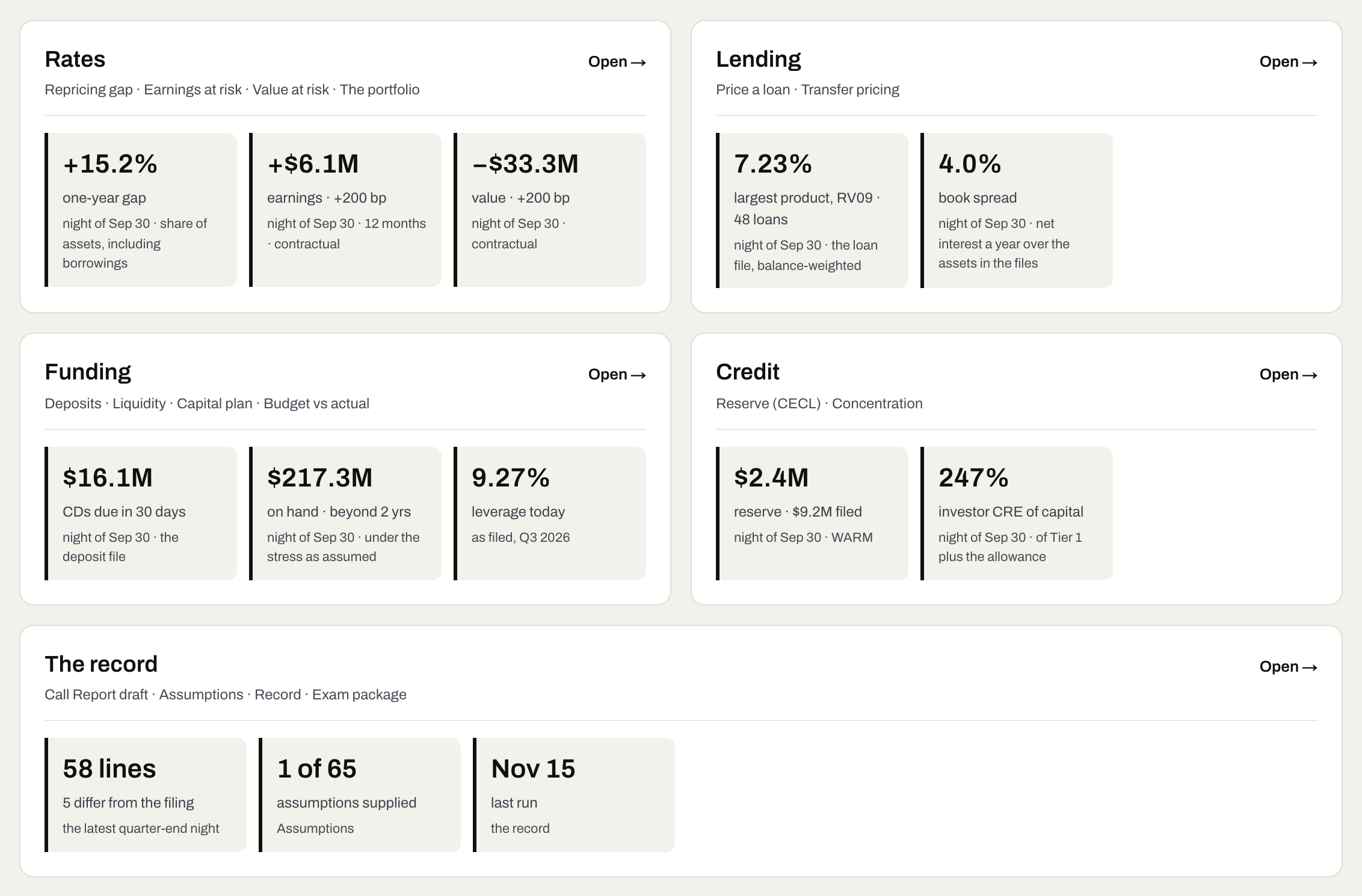
Five areas on your own numbers: Rates, Lending, Funding, Credit and The record. Each model shows its figure, one table and the assumptions it used. Move a dial and the table moves as a trial beside the saved figures; nothing is kept until you keep it. Every run is recorded with what it assumed.
Analytics: each model's figure, one table and the assumptions it used.
Market
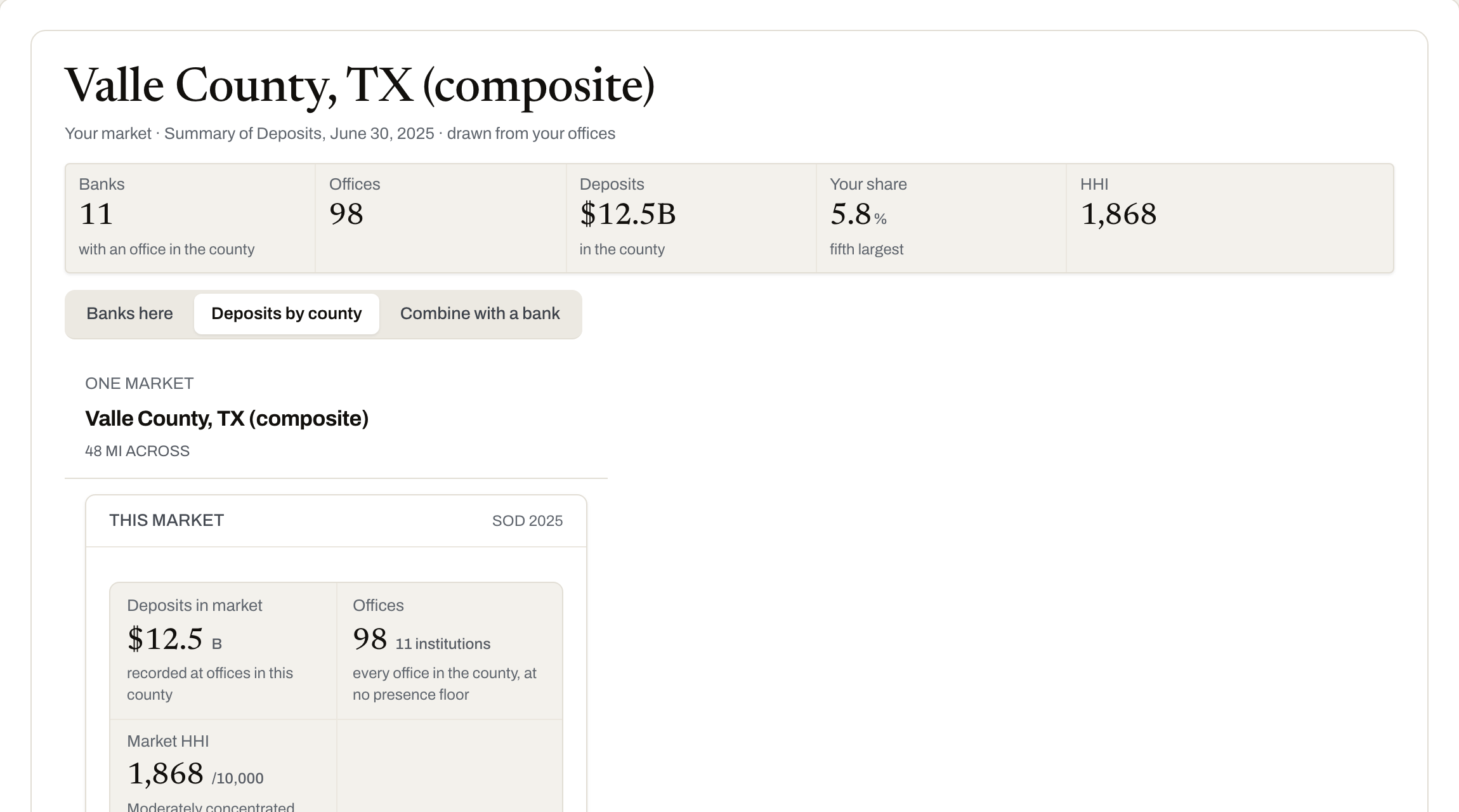
The banks in your market, deposits by county, and a combination with another bank, on one page. Draw a group from counties, a radius or a shape on the map; membership comes from the FDIC Summary of Deposits. Exclude a bank and it stays on your list, marked, with its offices off the map. A combination says which figures can be summed, which are recomputed from components, and which wait for deal terms. It is never a pricing comparable.
Market: the banks in a drawn area, with deposits by county.
The Balance Sheet
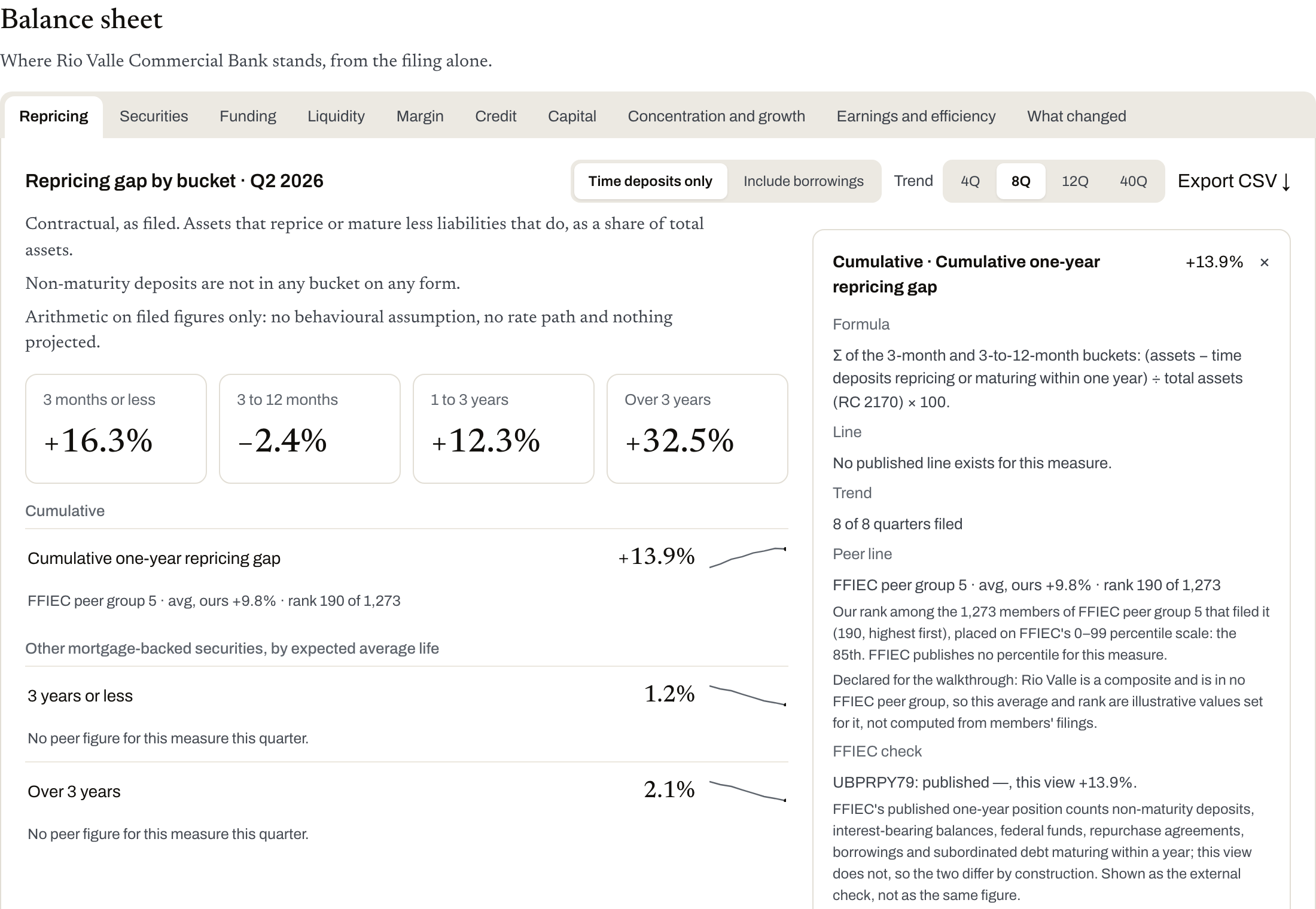
Ten views of your balance sheet from the filing alone: repricing, securities, funding, liquidity, margin, credit, capital, concentration and growth, earnings and efficiency, and what changed. Each measure carries its formula, the schedule lines it reads, its peer line, and what the filing cannot show.
The Balance Sheet: ten views, each measure with its formula and peer line.
Scenarios
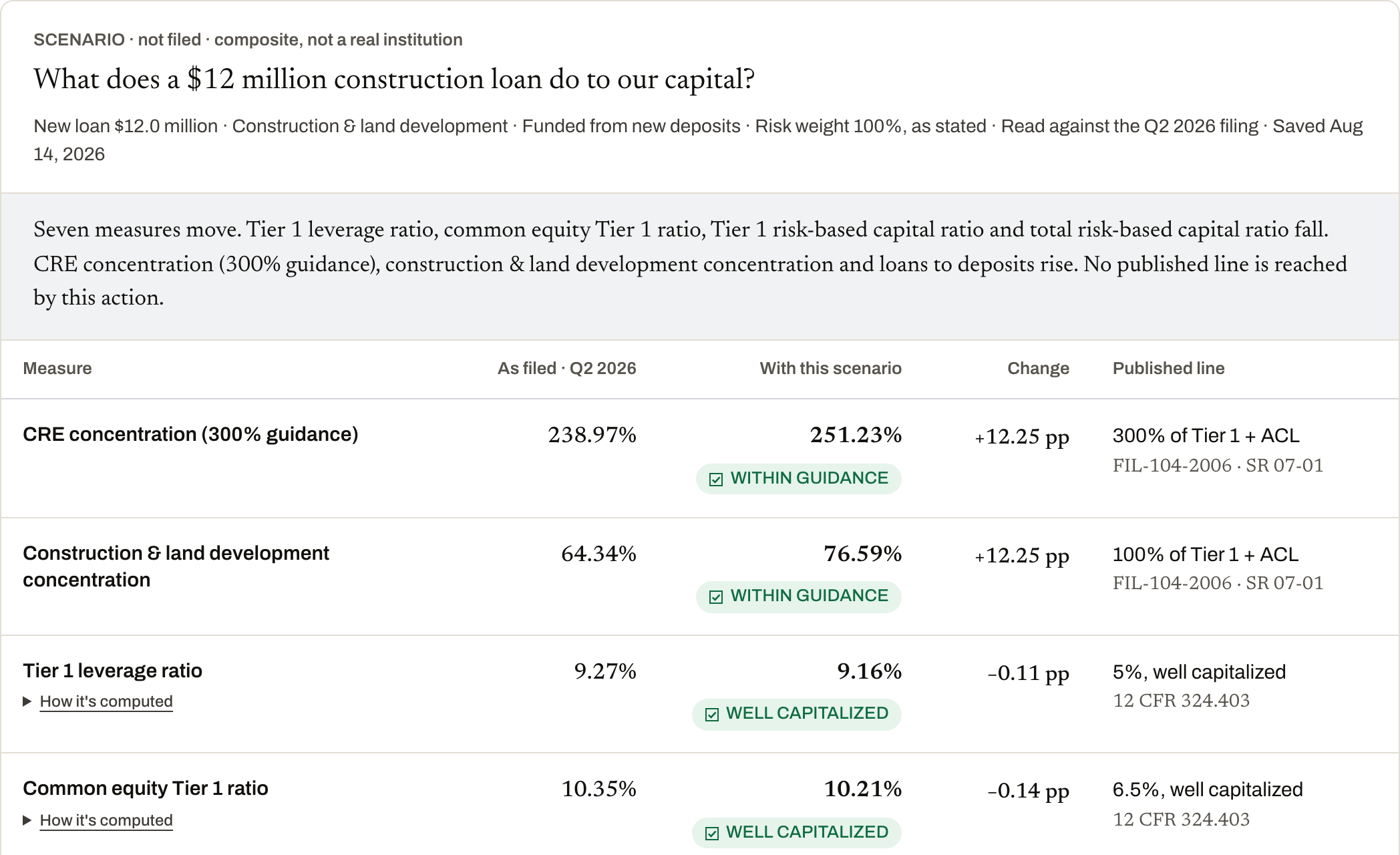
Actions you save against your own filing, held as the action and never as a result. Opening one runs it again against the filing held today, beside the figures as filed, with the published line on each measure it moves. A column says when the filing has changed under it, and every export is stamped as a scenario, not a filing.
Scenarios: the filing first, each saved action beside it.
Prepare
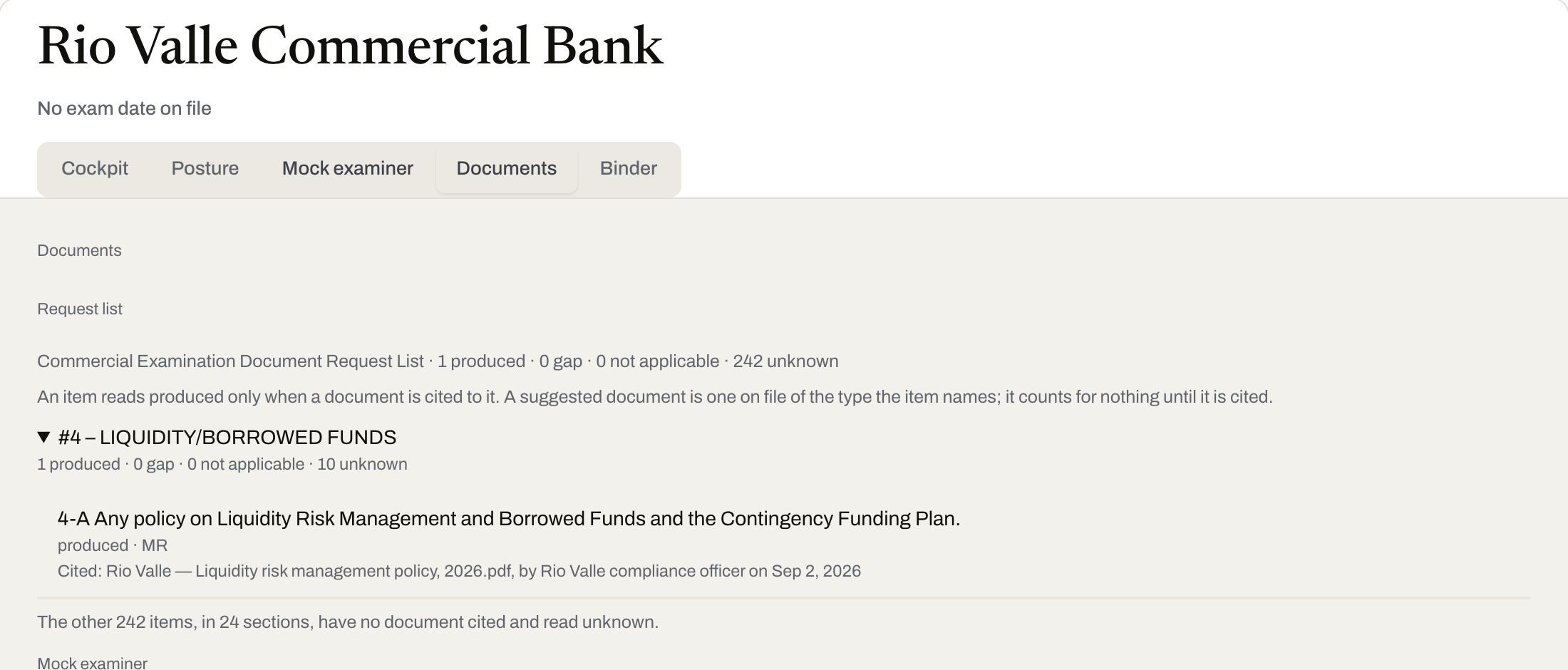
Exam preparation on the same record, not a second set of numbers. Your posture across the exam areas, the mock examiner, your documents in a hash-chained vault, and the binder you hand the examiner, with examiner guest access by token, scoped and logged. The rules engine reads the same metrics every other screen shows. Items your records already answer show as answered, with their date.
Prepare: what needs you, and what is already on record.
Proctor
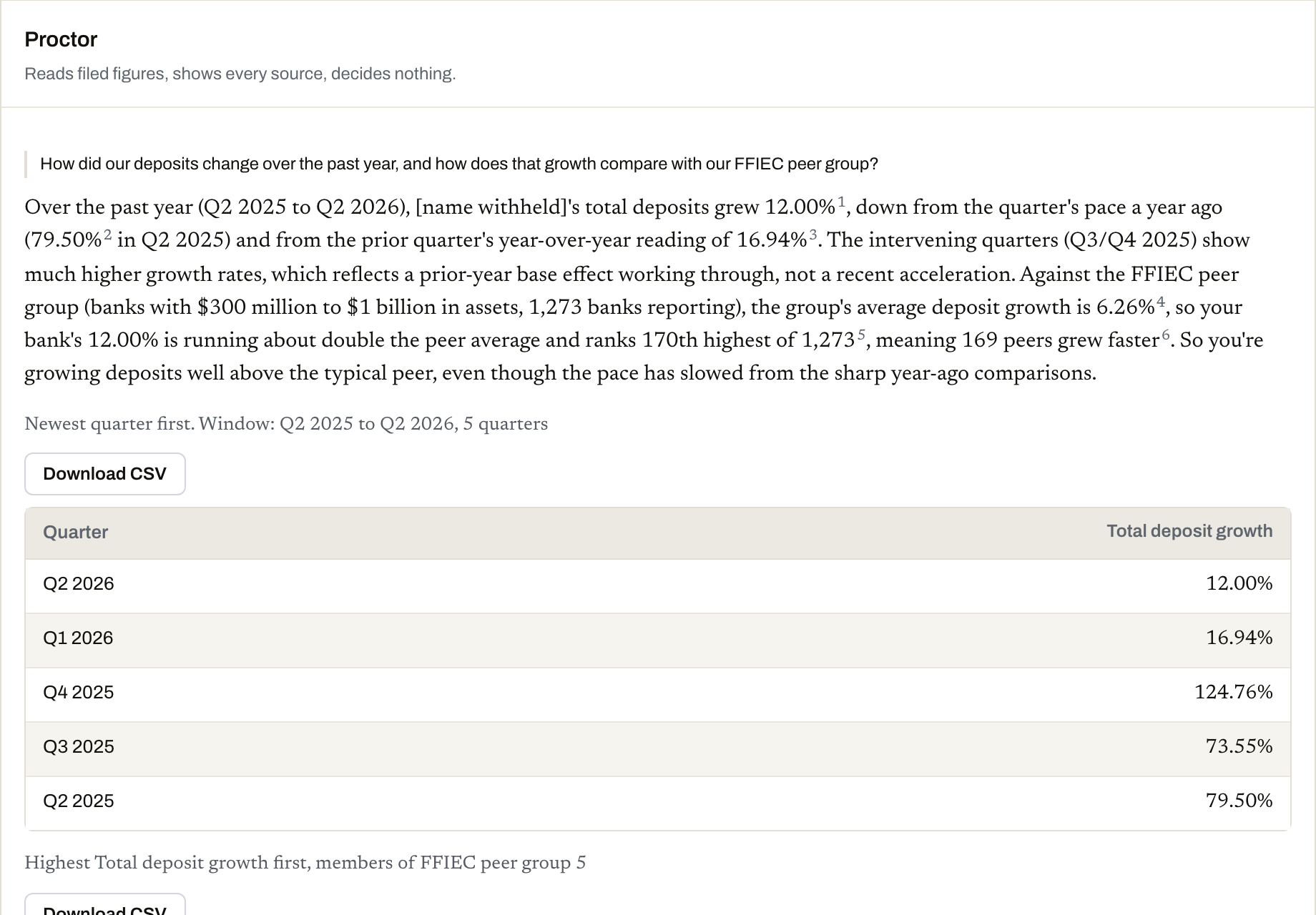
Ask your own question in plain words. Proctor answers from MDRM IQ's own tools and database: the tables those tools return are the record, with the source on every figure. It reads and never writes; anything it proposes waits for you to confirm it. It makes no recommendation and no exam prediction. Proctor is on the Platform plan.
Proctor: an answer with its tables and their sources.
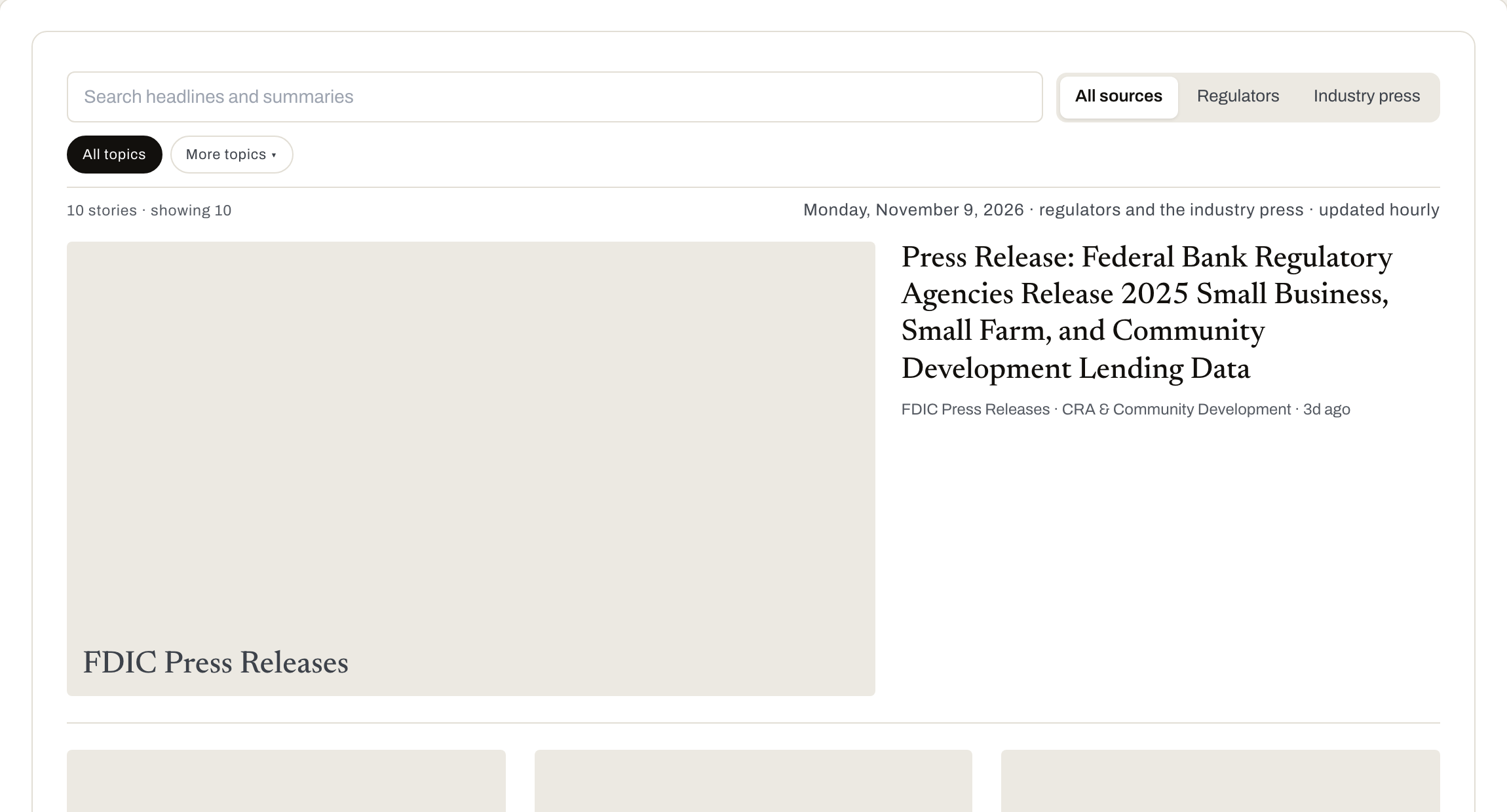
News
Regulator releases and industry reporting, each story tagged with the banking topics it touches. Every story links out to the outlet that published it, and its picture is the outlet's own, never copied.
News: banking stories, linked to the outlets that published them.
The rules
Every number says what it is.
Published or recomputeA figure the FFIEC published is labelled published. A figure we recomputed is labelled a recompute.
Theirs or oursFFIEC's trimmed peer average reads “trimmed avg, theirs”. An average we compute reads “avg, ours”, with the bank's rank.
No imputationA bank that did not report a measure is left out of the count, never filled in, and the count says how many were left out.
Gaps statedA coverage gap is stated on the row rather than filled in.
No invented thresholdWhere a threshold has no published source, the row says so rather than inventing one.
Criteria, not breachesSupervisory screening criteria are called criteria, not breaches. Guidance does not carry the force of law.
MDRM IQ is an informational tool. Nothing here is a rating, a finding or a prediction of an examination.
Questions
Which peer group do the peer figures use?
The one the FFIEC assigns your bank, the same group your examiner reads. FFIEC changed its peer group criteria on or shortly after February 26, 2026: groups are now set by asset size alone. Where the UBPR publishes a measure, MDRM IQ shows the FFIEC's trimmed average for your group and labels it as theirs. Where it publishes nothing, MDRM IQ averages the measure across your group's members and labels it as ours.
Can I use MDRM IQ figures in a regulatory filing?
MDRM IQ is an informational tool. The figures come from official sources and from your own files, but verify anything against your institution's own records before using it in a regulatory filing or an examination response.
How often is the data updated?
Call reports are filed quarterly and published by the agencies roughly 45 days after each quarter end. MDRM IQ loads a quarter as soon as it is available, and every surface names the quarter it is reading. Your own files are read each night they arrive. Regulatory news updates hourly.
Where does the data come from?
Four public sources: the FFIEC's Central Data Repository call report files (41 quarters of filings as reported), the FDIC's BankFind (each institution's identity, charter and supervisor), the FFIEC's published UBPR statistics (the trimmed averages and ranks for each bank's assigned peer group), and the FDIC Summary of Deposits (deposits by office). Regulatory news comes from the Federal Reserve, FDIC, OCC, CFPB, FinCEN and NCUA, plus industry publications. On the Platform, your bank's own files are added: the trial balances your core prints each night and your securities and borrowings each month, read for your bank alone.
See it on your own numbers.
Twenty minutes on your bank’s filing, and what your own files add.